Ashby Daniels

History rewards the long view

I'd argue the most universal tripping point investors face is the short-termism of the financial media. It's almost always about what's happening right now.

For instance, when was the last time you heard a pundit say, "In 10 years, I believe this will be a good trade"? I've never heard it. And yet, if you're an equity investor, that's just about the only thing that matters.

As you can see in the first chart below, since 1926 the S&P 500 (with dividends reinvested) has been positive in about 95% of 10-year periods, with a median and average return of roughly 10.5% to 11% a year.
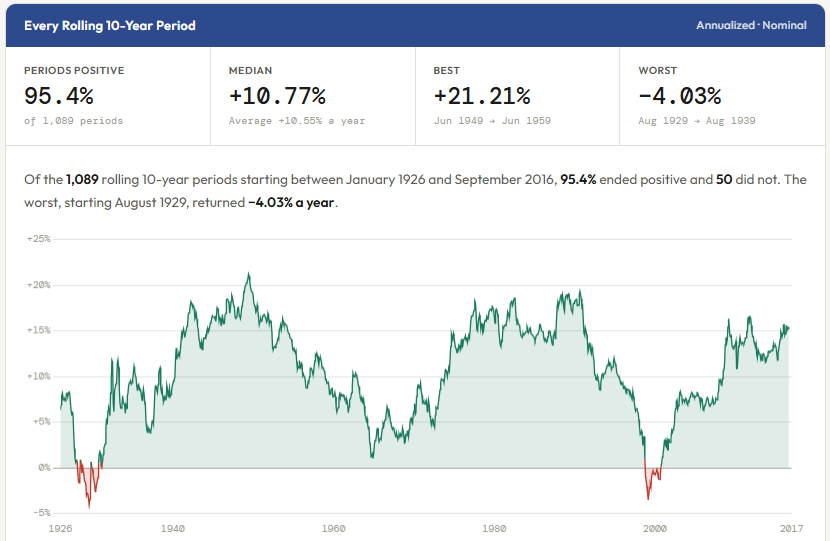
Line chart of S&P 500 annualized total returns for every rolling 10-year period starting January 1926 through September 2016, before inflation. 95.4% of 1,089 periods were positive. Median +10.77% a year, average +10.55%. Best: June 1949 to June 1959 at +21.21% a year. Worst: August 1929 to August 1939 at −4.03% a year. The only negative stretches started around 1929 to 1932 and around 1998 to 2000.
Annualized S&P 500 total returns for every rolling 10-year period starting January 1926–September 2016, before inflation, dividends reinvested. Market Return Data.

And if you extend the time horizon out to 20 years, as in the second chart, the market has been positive 100% of the time (before inflation), with a similar average and median.
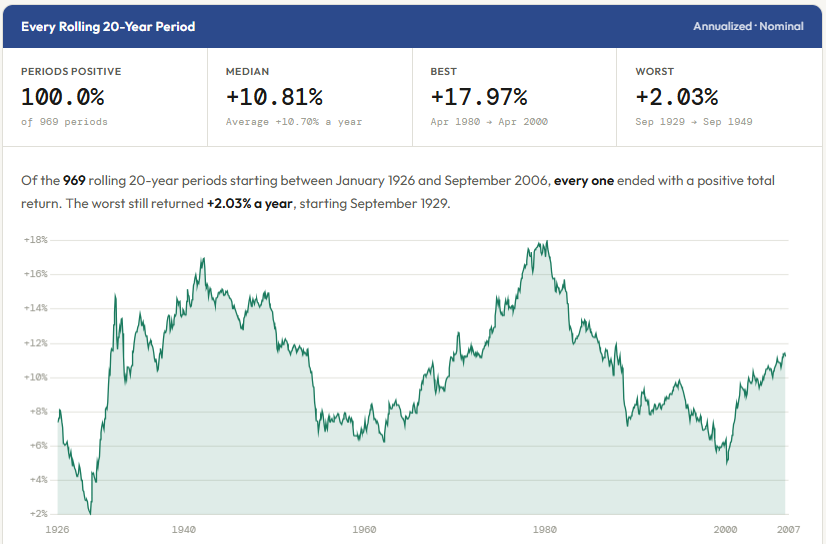
Line chart of S&P 500 annualized total returns for every rolling 20-year period starting January 1926 through September 2006, before inflation. All 969 periods were positive. Median +10.81% a year, average +10.70%. Best: April 1980 to April 2000 at +17.97% a year. Worst: September 1929 to September 1949 at +2.03% a year.
Annualized S&P 500 total returns for every rolling 20-year period starting January 1926–September 2006, before inflation, dividends reinvested. Market Return Data.

Thus, I'd argue the most important thing an investor needs to be successful (historically speaking) is a long-term perspective.

You can see how the market has done over other time periods on the rolling returns page.